

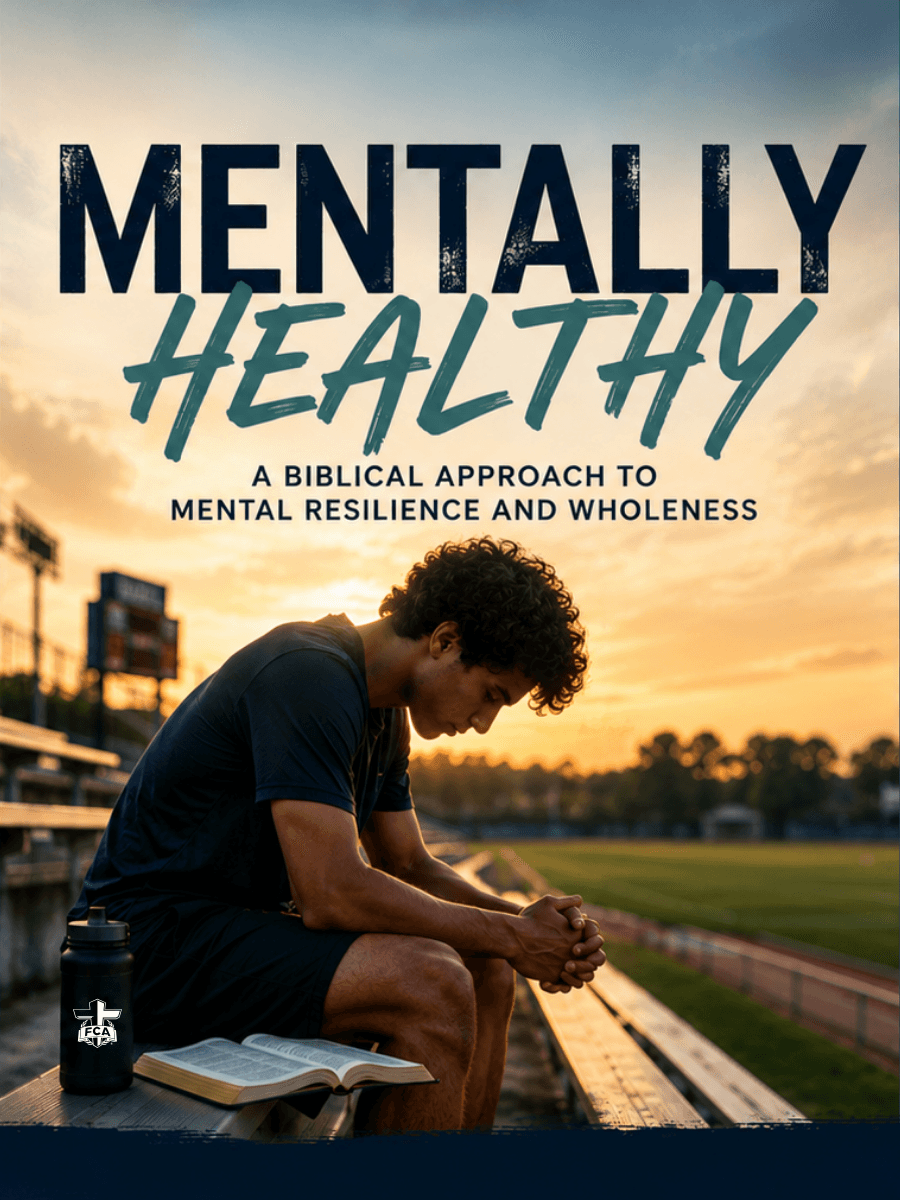
A Biblical approach to mental resilience and wholeness.
Disclaimer: This resource is shared to offer encouragement and awareness around mental health topics in the context of FCA’s ministry. It is not intended to provide counseling or medical advice, diagnosis, or treatment, nor to replace professional care. FCA encourages individuals to connect with someone you trust or a professional.
Opening
According to the Christian Athlete Report: Data, Trends and Opportunities, “It should hardly come as a surprise that mental health has become one of the most urgent and visible issues in athletics today. Athletes at every level (from elite to youth) report rising levels of anxiety, depression, and identity instability. Even coaches are experiencing similar patterns, often under immense pressure with little relational or institutional support.”
Mental toughness and training mindset reflects our physical, emotional and spiritual well-being. How we think affects how we feel, how we act and how we interact with the world around us. Sports psychologist Steve Magness points out, "Awareness is great, but when we’re inundated with constant streams of information telling us to focus on a problem, our brain gets the message, turning up the volume to validate that label or identity.”
As Christians, we look to Jesus with our whole being, body, mind and soul. We acknowledge that we live in a broken world, and life gets out of sorts sometimes. But in Christ, we are His, and our relationship with Jesus Christ is the anchor point as we work through our struggles.
This study is not about ignoring the mental struggle or pretending everything is fine. It’s about approaching the battlefield of the mind with the most powerful weapon available to us—the truth of God’s Word. We are not defined by what we deal with, and we tackle it with truth and wisdom, the anchor of our relationship with Jesus Christ.
Discussion Questions:
When life gets heavy—competition, losing, injury, team tension—where does your mind tend to go first?
What’s one thing you’ve been told about mental toughness that didn’t quite sit right with you?
What would it look like to approach mental strength from a faith foundation rather than willpower alone?
What does the Bible say?
Shalom—Whole Person Health
God designed us as whole people—and He cares about every part of us.
There is a word in the Hebrew Scriptures—shalom—that is often translated as “peace.” But shalom is bigger than peace. It means wholeness, completeness, flourishing. It is God’s design for every part of our lives: physical, emotional, mental, relational, and spiritual.
We are whole people. When one dimension of our lives is struggling, it impacts the others. An athlete who is emotionally depleted will feel it physically. A coach who is spiritually dry will feel it in their leadership. These are not separate compartments—they are interconnected.
This is why a biblical approach to mental toughness is not simply about managing thoughts or building grit. It is about pursuing whole-person flourishing—and inviting God into every part of that.
God Sees Your Inner Life
David narrowly escaped danger while fleeing from Saul (1 Samuel 21). He wasn’t writing from ease; he was in distress and in a state of fear. As you may experience a various state of mental unrest and emotional strain, know that God draws near. His nearness is not dependent on circumstances, but on condition of the heart. When David says, “brokenhearted” he’s referring to those who are crushed in spirit—emotionally, mentally and spiritually. God also wants to save you, not just physically, but as a call for restoration to your mind and your soul.
In times of pressure and defeat, remember God is very present and attentive. At times, when we’re full of fear or our bodies aren’t calming down, it may seem that God is standing passively in the corner, a casual observer to our struggle. We may feel lonely, forgotten or discouraged.
What do you do when your feelings and the truth of God’s Word don’t match? Scripture says, God is near when you’re broken. Acknowledge your feelings but be mindful about what you feel and who you are. Feelings are not fact, and holding to God’s truth in His Word allows us to stand on what remains accurate even when our feelings run contrary. You may feel lonely, but you are not alone.
Compete with this truth: “I may feel overwhelmed, but I am not alone. The Lord is near. He sees me. He strengthens me.”
Discussion Questions:
What does it mean that God “saves those crushed in spirit”? How might that salvation look different from physical rescue?
How do you think the principle “feelings are not facts” applies to an athlete’s mindset after a tough loss or a bad performance?
Train Your Mind with God’s Word
The Apostle Paul wrote this to fellow believers in Rome. This comes after 11 chapters of explaining the Gospel. In chapter 12, he shifts to application for the believers in sharing how to live in response to God’s grace.
“Do not be conformed” reminds us to not be shaped by the patterns (performance, comparison, pressure) of this world. Be transformed, Paul tells us. How? This transformation is internal, a heart and mind renewal that requires ongoing change to God’s will and thoughts for us. Mental health is not just about managing thoughts but transforming the source of those thoughts. The battlefield is the mind, but the tool is God’s truth.
Competitors are constantly discipled by sport culture. Romans 12:2 calls us to be discipled by Scripture instead. God’s Word reshapes our thinking. Here are four practical ways to train the mind with truth:
PRACTICE | HOW IT WORKS |
Start with one passage (1 Peter 5:7) | Find a verse that speaks to what you’re carrying. Ask: What does this say about God? What does this say about me? What does it invite me to do? |
Replace the lie with truth | When you think “I am failing,” replace it: “My identity is in Christ, not my performance.” This is formation of the mind. |
Word before world | Before your phone in the morning, read one short passage. Give your mind a place to land before the noise begins. With five minutes, having Scripture to hold to as you go into your day starts your heart and mind on the right track. |
Pray Scripture | When life is hard and thinking clearly feels impossible, pray a passage aloud. Let God’s own words say what you need. |
Be patient with the process. Habits don’t form overnight. Give yourself grace while you build new rhythms.
A stronghold is any pattern in thinking that has built a fortress against the truth of God. Negative self-talk. Fear of failure. Shame after a loss. These aren’t just mental habits—they are spiritual battles. And they are not won by hustle. They are won by taking every thought captive to Christ.
Discussion Questions:
What messages does your sport culture consistently send you about your worth, identity, or what it means to be mentally tough?
What is one specific thought pattern—a recurring lie or distortion—that you’d like to replace with a biblical truth? What verse would you use?
What messages does your sport culture consistently send you about your worth, identity, or what it means to be mentally tough?
We are invited to bring our anxieties to Him
Paul wrote Philippians from a prison cell. Despite the circumstances shared in this letter, he is joyful and at peace. Although Paul may be anxious, he doesn’t dismiss it, but also redirects his thinking. Peace comes through surrender, not control. God doesn’t always remove the pressure, yet He protects us while we’re in it. Instead of internalizing stress, practice prayer. Go to God in prayer in the midst of high-pressure situations.
Discussion Questions:
Paul describes a sequence: don’t worry → pray with thanksgiving → receive peace. Where in that sequence do you tend to get stuck?
How does gratitude factor into releasing anxiety? Why do you think Paul connects thanksgiving with petition?
True peace is found in Christ, not circumstances
In this passage, Jesus prepares His disciples for difficulty the night before His crucifixion. One of the most pressure-filled moments in all of human history. He is shielding them from suffering. He tells us that in this world we will have trouble.
Then He said something that should reshape every competitor’s understanding of resilience: “Be courageous! I have conquered the world.” The courage He calls us to is not the absence of fear. It is confidence that is grounded in what He has already done.
In sports, we often define mental toughness as the ability to push through difficulty with grit and willpower. But biblical mental toughness is the settled confidence of a person who knows they are held by the One who has already won. The scoreboard or rank doesn’t determine your worth. The outcome doesn’t define your identity. Your peace is found in your Savior not stats.
PERFORMANCE-BASED IDENTITY | CHRIST-BASED IDENTITY |
My worth = my stats | My worth = who I am in Christ |
A bad game means I am bad | A bad game is not my identity |
I must perform to belong | I belong because of grace, not achievement |
My peace depends on outcomes | My peace comes from Christ, who has conquered |
Fear of failure drives me | Faith and purpose drive me |
Discussion Questions:
Jesus promised both suffering AND peace in the same breath. How does that reframe what “mental toughness” means for a follower of Christ?
What does it mean practically to “be courageous” when the scoreboard isn’t in your favor or the season has gone sideways?
How would your team culture change if everyone operated from Christ-based identity instead of performance-based identity?
Mental toughness built on the Word of God is not fragile. It doesn’t fall apart when the score is wrong, when the season crumbles or when the feelings are heavy. It is an anchor—rooted in who Christ is and who He says we are.
Our identity, stability, and peace are rooted in God—not in performance, outcomes or emotions.
Additional Resources:
Parents interested in discussing matters with your teenage athlete. Axis provides Biblical resources to help parents disciple their teens.